· Tim Moore · 4 min read
Why AI rewards smaller, sharper teams and punishes coordination overhead
As AI reduces the cost of analysis, drafting, and routine coordination, the organisations that benefit most may not be the biggest. They may be the ones that can move with the least internal friction.

One of the easier mistakes to make in AI strategy is to assume that larger organisations automatically gain the most from the technology.
That sounds plausible at first. Bigger firms have more data, more budget, more use cases, and more people who could in theory benefit from automation. But in practice, AI does not just amplify resources. It also exposes friction.
That matters because many large organisations are full of friction.
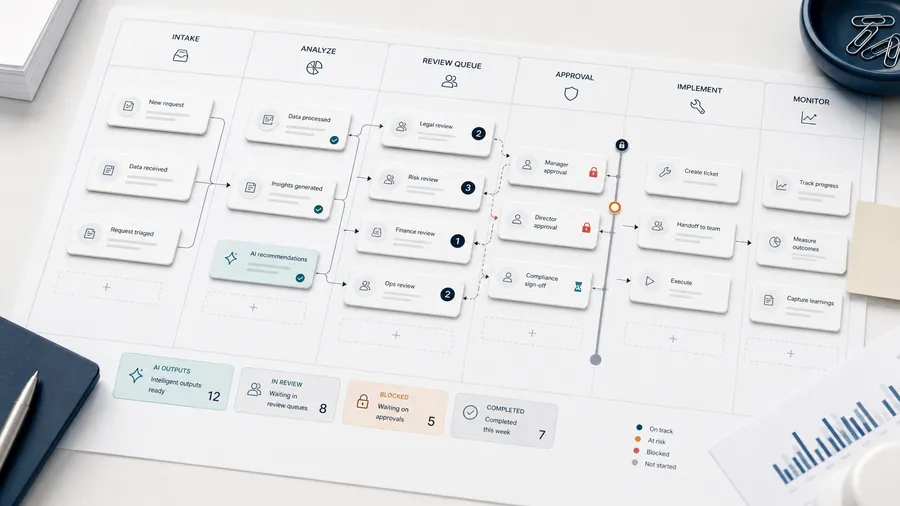
They rely on meetings to align work, approvals to move decisions forward, and layers of coordination to keep teams pointed in roughly the same direction. Those costs were already real before AI. The difference now is that the cost of execution in many workflows is falling faster than the cost of coordination.
That changes the economics of how teams create value.
AI lowers the cost of doing, not the cost of waiting
AI can now help teams draft material faster, prepare analysis more quickly, summarise information, route tasks, and support execution with much less manual effort than before.
In many workflows, the time spent producing the first useful output is shrinking.
But the time spent waiting for sign-off, aligning multiple stakeholders, clarifying ownership, or carrying work across functional boundaries often does not shrink at the same rate.
That creates an uncomfortable result for coordination-heavy organisations. The work itself becomes cheaper, while the management overhead around the work stays stubbornly expensive.
In some cases, the relative cost of coordination becomes more visible than the work it was meant to control.
Smaller teams often benefit first
Smaller teams usually have a simpler operating environment.
They often have:
- clearer ownership
- fewer handoffs
- less political negotiation
- shorter feedback loops
- less distance between analysis and action
That does not automatically make them better. Plenty of small teams are chaotic. But where a small team is already reasonably well-led, AI can give it disproportionate leverage.
A team that used to need several people to gather information, draft outputs, prepare updates, and coordinate routine tasks may now be able to do the same work with fewer delays and less internal choreography.
The gain is not only labour efficiency. It is operating sharpness.
When fewer people are needed to keep the machine moving, the team can spend more time on judgement, prioritisation, and response.
Large organisations are not doomed, but they do have a design problem
This does not mean large organisations cannot win with AI. Many will.
But they are unlikely to do so simply by dropping AI tools into existing structures and assuming the benefits will flow through.
If the organisation keeps the same approval chains, the same committee logic, the same fragmented ownership, and the same management routines, AI may improve local productivity while leaving the operating model itself largely unchanged.
The result is often disappointing. Teams generate more output, but decisions do not move faster. Analysis arrives sooner, but action still stalls. More tasks can be completed, but exceptions still sit in the same queues.
That is not a model problem. It is an organisational design problem.
Coordination overhead is becoming a strategic liability
For years, coordination overhead was treated as an unfortunate but tolerable cost of scale.
Now it is becoming something more consequential.
If one organisation can move with a smaller, sharper team supported by AI, while another still needs layers of managerial and cross-functional effort to reach the same point, the difference will show up in responsiveness, cost, and learning speed.
That gap may become a real competitive issue.
The stronger question is not whether AI can make individual employees more productive. In many cases, it already can.
The stronger question is whether the organisation can redesign itself so that the gains are not absorbed by drag elsewhere in the system.
What leaders should examine first
Leaders do not need to start by restructuring the entire company.
The better starting point is often much narrower.
Look for areas where:
- a small team already owns an important workflow
- coordination costs are obvious
- handoffs and approvals consume disproportionate time
- AI could reduce preparation, synthesis, or routine task load
- the effect of a redesign could be measured
That allows the organisation to test a more AI-enabled operating shape in one real environment rather than debating it in the abstract.
In some cases, the lesson will be that the work can be handled by a smaller, clearer team than before. In others, the lesson will be that the bottleneck is not skill or effort at all, but the structure around the work.
Both are useful findings.
The winners may not be the biggest
AI does not only reward scale. It rewards clarity.
It rewards organisations that can turn information into action without dragging every decision through unnecessary layers of coordination. It rewards teams that know who owns the work, where judgement belongs, and how exceptions are handled.
That is why smaller, sharper teams may often move first.
And it is why large organisations should pay close attention to the cost of their own internal drag. In the AI era, coordination overhead is no longer just an efficiency issue. It is becoming an operating risk.
- Operating model
- Team design
- Workflow redesign