The most effective AI projects start with examining value chains and workflows.
Most value chains were designed in the pre-AI era. They were constrained by human capabilities and throughput. With AI on the team, whole value chains can be re-invented. This can lead to new products, new markets and increased capabilities.
The workflows within those value chains were built for humans to execute, and while using tools to make them run better is a step in the right direction, more value can often be obtained by redesigning them to be executed by AI with human oversight.
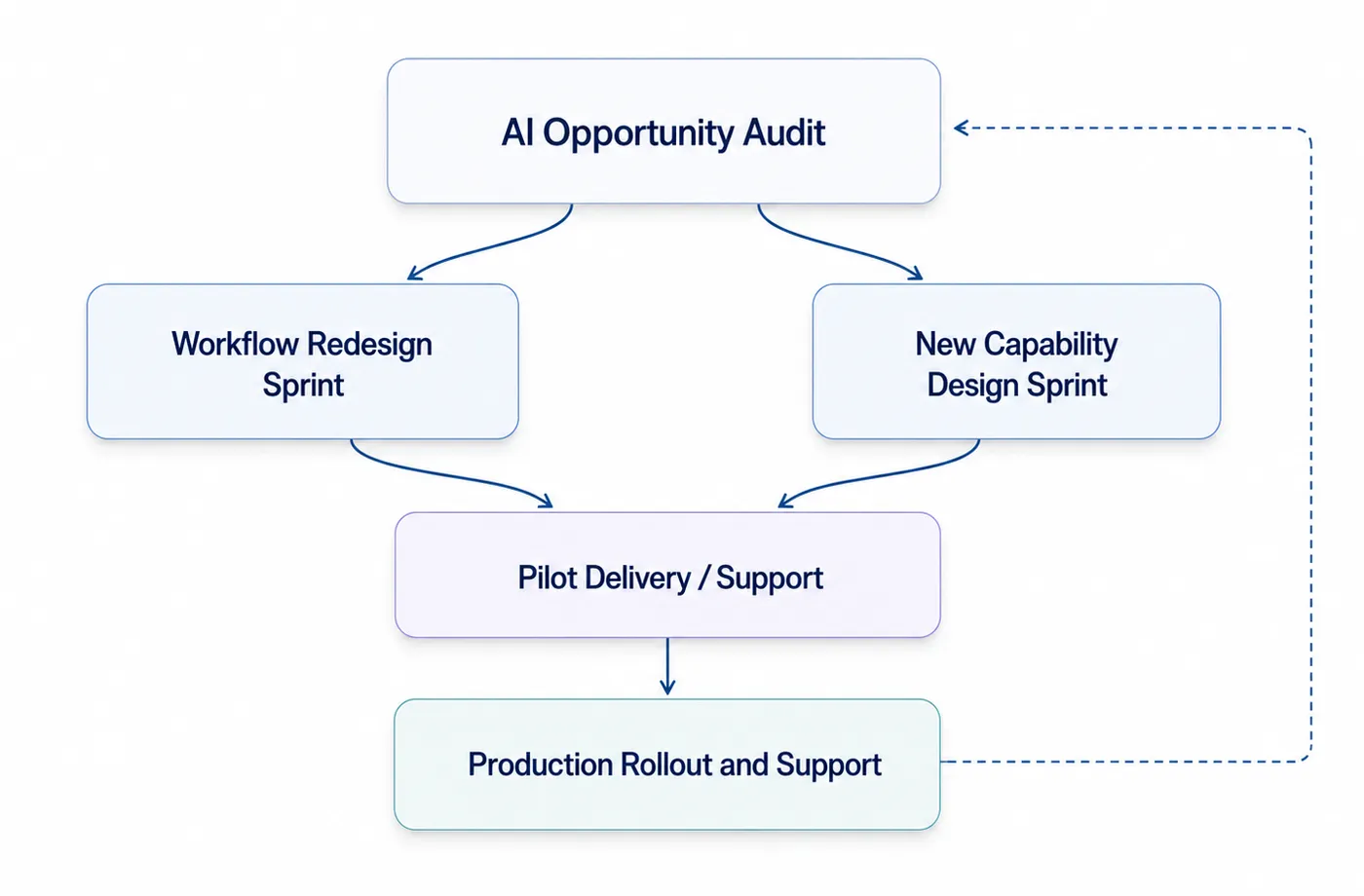
Our projects usually start with an AI Opportunity Audit - a brief deep dive into your value streams and workflows to identify where AI has the potential to transform. Recommendations are categorised into workflow redesign or new capability opportunities and prioritised in terms of impact.
The highest value opportunity is chosen, resulting in either a Workflow Redesign Sprint or a New Capability Design Sprint. In both cases, we work with you and your team to design a solution.
This is followed by a pilot that runs safely alongside your existing workflows, shadowing them rather than replacing them. The solution is adapted until it significantly outperforms the status quo. We can deliver the pilot directly or work more on an advisory basis, supporting your internal change team. The solution is then carefully rolled out into production.
Optionally, this process starts again to transform adjacent workflows. This iterative approach is both safe and pragmatic.