· Tim Moore · 3 min read
How medium-sized businesses can start with AI workflow redesign
The best starting point is rarely an enterprise-wide program. It is usually one workflow with visible friction, meaningful value, and an owner willing to change how the work gets done.
Many medium-sized businesses know they need to do more with AI, but that does not automatically tell them where to start.
That is where a lot of good intentions become unhelpful programmes.
The leadership team can see the direction of travel. Execution is getting cheaper. Analysis, drafting, routing, and research can all move faster than they used to. But the business still has to decide what to change first, who owns it, and how to avoid creating a noisy pilot that goes nowhere.
In practice, the best starting point is usually not an enterprise-wide initiative. It is one workflow.
Not just any workflow. One that is important enough to matter, narrow enough to change, and concrete enough to measure.
Start where friction is visible
The strongest early candidates usually share a few traits.
They are commercially relevant. They create obvious delay, rework, or management frustration. They depend on too much manual synthesis or too many handoffs. And they have an owner who is willing to redesign the work rather than simply add a tool to it.
That matters because a medium-sized business does not need a grand theory of transformation before it starts. It needs a clear problem worth fixing.
Good starting points often include workflows such as:
- sales proposal support
- customer-service escalation handling
- invoice and finance operations
- management reporting
- internal knowledge retrieval
- compliance evidence gathering
The common feature is not the function. It is the presence of drag.
Avoid the workflows that look important but are hard to change
There are also predictable places to avoid.
Do not start where ownership is unclear, where the process is already being reorganised for other reasons, or where success cannot be measured in operational terms.
It is also worth being careful of workflows that attract endless stakeholder commentary but very little real commitment. Those often produce activity without progress.
If every team wants something different from the pilot, the pilot will usually become a negotiation exercise rather than a redesign exercise.
Simplify before you automate
One of the more useful disciplines at this stage is to ask whether the workflow is already more complicated than it needs to be.
If a process currently takes ten steps, the first question is not always where AI fits. Often it is whether the process should still take ten steps at all.
That is where medium-sized firms can move well. They are often less constrained than large enterprises, but only if they are willing to remove unnecessary approvals, tidy ownership, and reduce handoffs before layering new capability on top.
In other words, do not automate coordination drag if you can first remove some of it.
A practical first sequence
The strongest early sequence is usually quite simple.
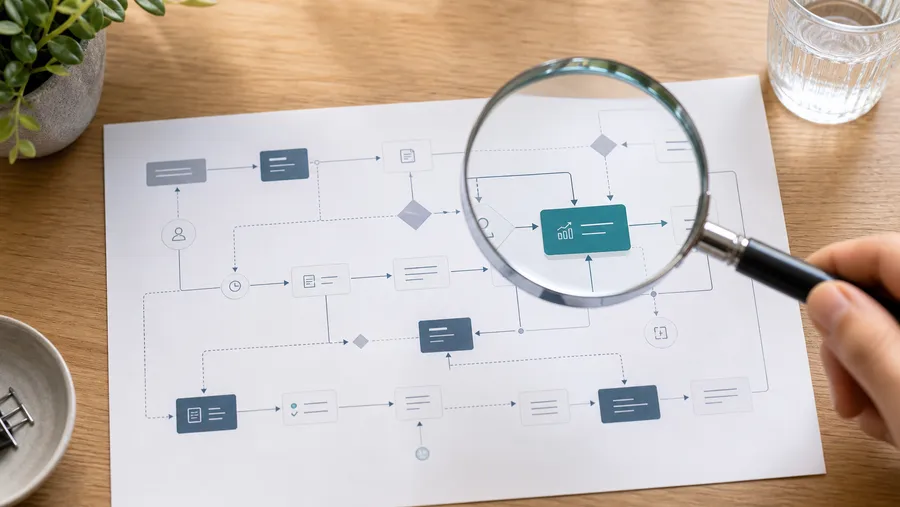
- Map the current workflow and identify where time is actually lost.
- Strip out any approvals or handoffs that exist mainly because the old process had no better option.
- Decide where AI should sense, summarise, draft, recommend, or route work.
- Define where human judgement still matters and how exceptions should be handled.
- Run a narrow pilot with real users, real work, and a small number of operational measures.
That is enough to learn something useful without overcommitting.
The goal is not to launch a programme. It is to prove a better way of working.
Medium-sized companies do not need to copy the playbook of much larger organisations.
They usually do better when they start with one workflow, one owner, one measurable source of friction, and one clear improvement that leadership can see.
That first success does more than prove that AI can produce output. It shows that the business can redesign work around intelligence, automation, and human judgement without losing control.
That is a much better foundation to build on.
- Mid-sized business
- AI transformation
- Workflow redesign