· Tim Moore · 4 min read
The case for human oversight in agentic operations
The point of human oversight is not to slow agentic operations down. It is to make faster execution trustworthy, governable, and commercially usable.

One of the weaker ideas in AI operations is that human oversight is mainly there to slow things down.
In practice, the opposite is often true. Good oversight is what makes faster execution usable inside a real business.
Without it, teams don’t have confidence in the system, leaders don’t know where accountability sits, and exceptions end up being handled ad hoc. The result isn’t speed. It is hesitation.
That matters because agentic operations change more than the cost of execution. They also change the cost of acting, escalating, approving, and coordinating work. Once those things become cheaper, the operating question changes with them.
The useful question isn’t, “How do we keep people in the loop?”
It is, “Where does human judgement still create the most value once agents can do much more of the sensing, drafting, routing, and execution?”
That is a design question, not a philosophical one.
Oversight is not the same as manual review
Human oversight does not mean a person checking every action individually.
It usually means setting clear boundaries around:
- what the agent can do on its own
- what it can recommend but not complete
- what confidence threshold triggers review
- what exceptions must be escalated
- what can be rolled back if something goes wrong
Those are very different things.
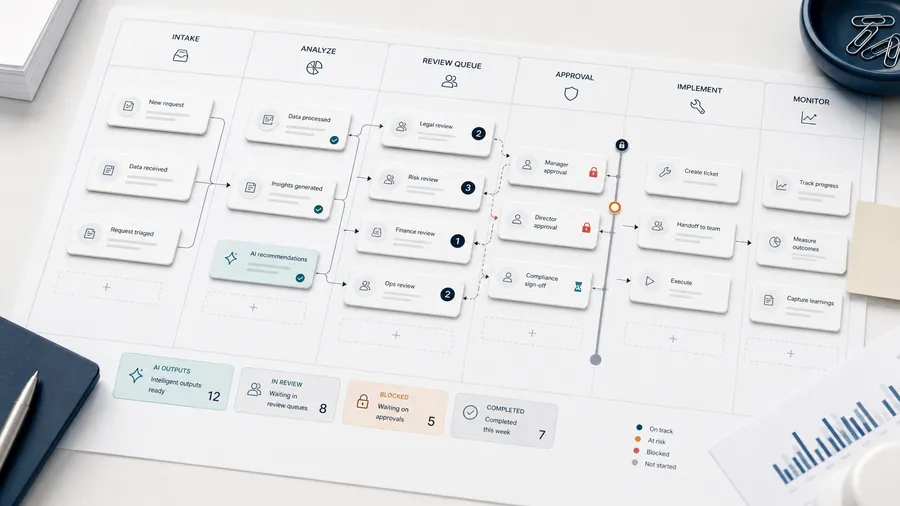
In a well-designed workflow, most activity should move without unnecessary friction. Human attention should be reserved for judgement, ambiguity, policy exceptions, material risk, and decisions that genuinely need accountable ownership.
That is why oversight should be thought of as architecture, not supervision.
The risk is not just error. It is unmanaged action.
When organisations talk about AI risk, they often jump straight to obvious failure cases: a wrong answer, a hallucinated summary, a bad classification, a poor recommendation.
Those matter. The bigger operational problem is often what happens when an agent acts inside a poorly governed system.
If there is no clear log of what happened, no review queue, no rollback path, and no rule for when a person must step in, a small error becomes much harder to contain. A low-quality process can absorb that kind of uncertainty for a while when everything is manual. It becomes much more dangerous when the system can move quickly.
That is why stronger agentic operations need:
- explicit approval thresholds
- searchable logs
- clear escalation paths
- rollback options
- named owners for exceptions and outcomes
Without those, the organisation is not really running an agentic workflow. It is just moving risk faster.
Human judgement moves up the stack
One practical misunderstanding is the idea that human involvement should stay exactly where it was before, only now with AI alongside it.
That usually recreates the old bottlenecks.
The better model is that people stop doing as much low-level coordination and spend more time on:
- monitoring patterns
- handling exceptions
- reviewing edge cases
- improving rules and routing
- deciding when the system should be trusted and when it should not
That is a higher-value role.
It also tends to be where businesses actually need experienced people. Most organisations do not struggle because there are too few humans forwarding work between teams. They struggle because there is too little time for judgement, problem-solving, and operating improvement.
Oversight is what makes scale credible
A pilot can get away with informal control for a while. Production operations can’t.
Once an AI-enabled workflow starts touching real customers, financial decisions, compliance activity, pricing logic, supplier interactions, or management reporting, the standard changes. Leaders need to know:
- who is accountable
- what the system is allowed to do
- how exceptions are surfaced
- how decisions can be reviewed later
- what happens when the workflow goes off pattern
That is not bureaucracy for its own sake. It is the difference between an interesting demo and an operating model that the business can actually rely on.
In practice, teams usually adopt AI faster when these rules are clear. People trust the workflow more because they know where the edges are.
The goal is not less human involvement. It is better human involvement.
The case for human oversight is not that people should hover over every automated action.
It is that as execution becomes cheaper, human judgement becomes more concentrated and more important.
The strongest agentic operations do not remove human accountability. They redesign it. People are no longer there to perform every step manually. They are there to govern the system, intervene when needed, and improve it over time.
That is what makes speed sustainable.
If you’re exploring this in practice, our services focus on governed AI implementation rather than unconstrained automation.
- AI governance
- Human oversight
- Agentic workflows