· Tim Moore · 4 min read
Why AI pilots fail inside legacy workflows
Many pilots disappoint not because the model is weak, but because the surrounding workflow still depends on slow approvals, fragmented ownership, and manual coordination.
One of the more common mistakes in AI work is treating the pilot as the change.
The team introduces a model, gives it a narrow task, measures a few outputs, and then wonders why the result feels underwhelming. The assumption is usually that the model was not capable enough, the prompt was not refined enough, or the data was not quite ready.
Sometimes that is true. More often, the pilot has been dropped into a workflow that was already too slow, too fragmented, or too dependent on human coordination to benefit much from the new capability.
That matters because AI does not only change what can be produced. It changes what should happen around the work.
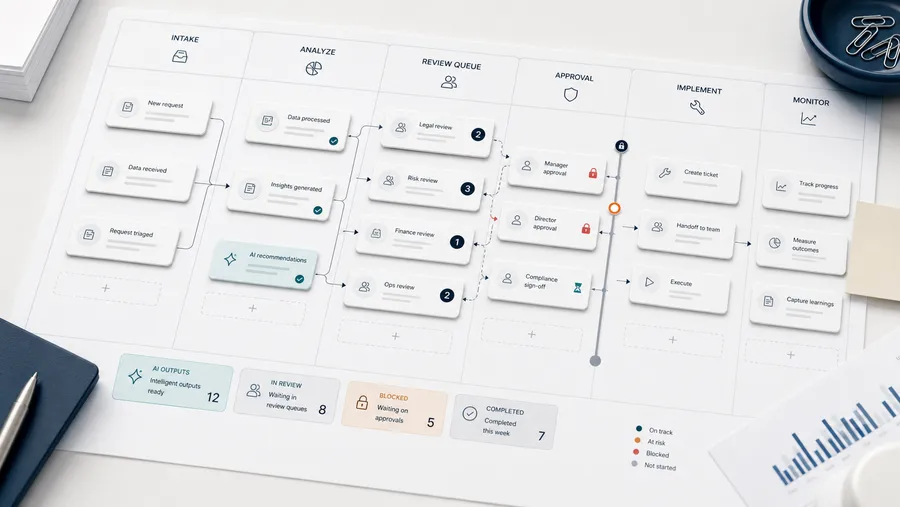
If the surrounding operating model still depends on inbox triage, meeting-heavy approvals, multiple handoffs, and unclear escalation rules, a pilot may generate impressive-looking output without changing the speed or quality of execution in any meaningful way.
The model is rarely the whole intervention
In a weak workflow, the model becomes another component that needs to be reviewed, checked, forwarded, discussed, reformatted, and re-entered elsewhere.
The work may be technically better. The organisation may still not move.
That is the point many AI pilots miss. The bottleneck isn’t always the production of analysis or draft output. In many businesses, the bigger bottleneck is what happens next.
Who owns the decision? Who is allowed to act? What happens when confidence is low? Where do exceptions go? Which steps still require human judgement, and which ones merely exist because the workflow was built for a slower era?
If those questions remain unanswered, the pilot is being asked to perform inside a system that has not been redesigned to use it well.
Legacy workflows absorb the gains
This is where disappointment sets in.
The team expected acceleration. Instead, it got local improvement trapped inside old operating logic.
Common failure patterns include:
- The pilot produces recommendations, but nobody owns acting on them.
- Teams still wait for the same approval chain before any decision is made.
- Outputs are useful in theory but do not fit the way work is actually reviewed, escalated, or measured.
- Users are asked to copy results manually between tools and processes.
- The pilot creates more material to inspect, but not a better decision process.
- The new capability reduces execution effort, while coordination overhead stays exactly where it was.
In other words, the gains are absorbed by the workflow instead of released by it.
The stronger approach is to redesign around intelligence
The stronger question is not, “Where can we place a model?”
It is, “How should this workflow now be organised if analysis, drafting, routing, or synthesis have become much cheaper?”
That leads to a different design conversation.
It means asking:
- What decision should happen faster?
- What information should be sensed or summarized automatically?
- Where is human judgement still essential?
- What should happen when confidence is low or exceptions appear?
- Which approvals exist for control, and which ones survive only because the old process had no better alternative?
- Who owns the workflow end to end once the pilot is live?
That’s a redesign exercise, not a tool deployment exercise.
A good pilot changes the workflow, not just the task
A pilot becomes much more credible when it is attached to:
- a workflow with a clear owner
- a measurable bottleneck
- explicit operating rules
- defined human review points
- a real path from signal to action
That does not mean automating everything. It means being more disciplined about where the AI acts freely, where it prepares a decision, and where a person must still decide, approve, or intervene.
In practice, the best early pilots are often narrow but structurally meaningful. They do not try to prove that the model can do something clever in isolation. They prove that the business can run that slice of work better, faster, or with less friction because the workflow itself has been adapted.
This is why some pilots scale and others stall
When leaders say an AI pilot failed, they’re often collapsing two very different things into one judgement:
- the capability may have worked
- the operating environment may not have
If the capability worked but the workflow did not change, the lesson isn’t necessarily that the technology was wrong. The lesson may be that the organisation tried to insert an AI-native capability into a human-centric operating design and expected the result to look transformational.
It rarely does.
That is why narrow workflow redesign often matters more than broad AI experimentation.
The goal is not to demonstrate that AI can generate output. The goal is to prove that the business can operate better with it.
That is the purpose of our AI Opportunity Audit and pilot approach.
- AI pilots
- Workflow redesign
- Operating model